
Lawn Mower Repair in Gulf Cove, FL
Gulf Cove is the kind of neighborhood where the boat ramp is private, the homes are established, and a good recommendation travels over the fence before dinner. Our mowers-only shop sits about 15 minutes up SR 776 in Port Charlotte, the kind of directions that fit in one sentence at the ramp.
Gulf Cove, got a mower problem? Joe’s Small Engine Repair fixes the neighborhood’s walk-behinds, riders and zero turns from Port Charlotte, a straight 15 minute run up SR 776 from the boat ramp side of 33981. Bring it up, or book the trailer and we come to you. Price approved by you before a single part moves. Text or call (941) 555-0123.
The Riverfront Neighborhood That Compares Notes
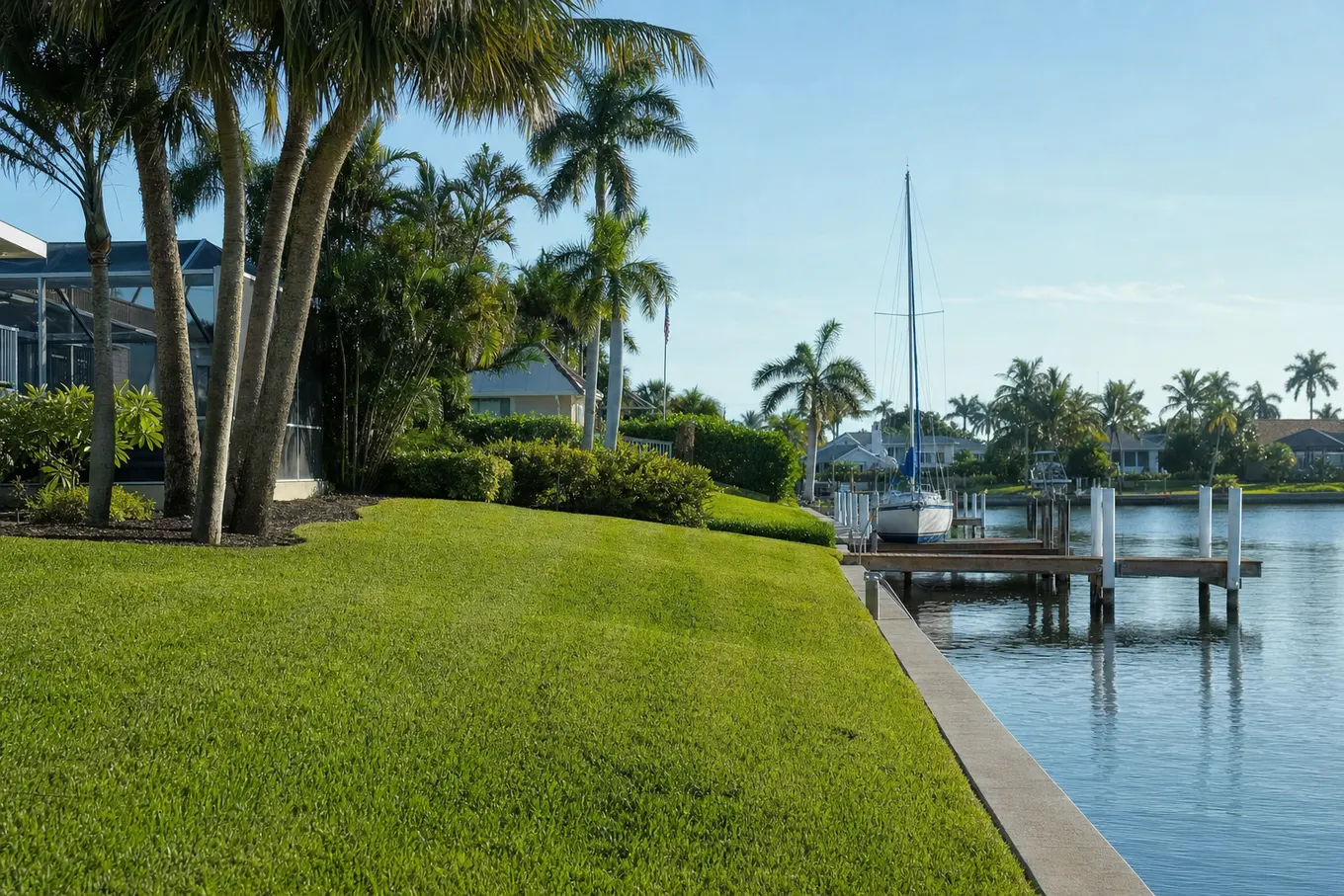
Gulf Cove grew up along the Myakka the unhurried way: a few thousand people on established lots off SR 776, with the community’s own private boat ramp as the local badge of honor. Nobody moved there for nightlife. People moved there for the river, the space and neighbors close enough to wave at but far enough not to hear.
Neighborhoods like that share information the old way. Ask about a plumber, a fishing spot or a mower shop over the fence and you get an answer with a story attached. It also means the lawns share conditions: sandy soil that dulls blades ahead of schedule, river humidity quietly rusting deck seams, and a fleet of veteran mowers on established properties where equipment gets kept, not flipped. And because the boat is the favorite child, more than a few of those mowers run months past their service dates.
All of it is familiar work for us. The shop is one straight shot up 776, about 15 minutes away, and a repair that holds is exactly the kind of news that travels fence to fence out there. We aim to be that news.
Gulf Cove Wear Patterns, Straight From the Bench
Sandy ground, river air and busy boat trailers each leave fingerprints on a mower. Here is what your neighborhood’s machines show us.
The boat gets Saturday, the mower gets whatever is left
No judgment, the ramp is right there. But we can usually spot a boat household’s mower on the bench: oil dark and low, gas from three months ago, a blade that has not seen a grinder since purchase. Deferred maintenance does not kill machines outright, it stacks small stresses until one hot afternoon in August they cash out together.
The efficient move is one honest catch-up service: fluids, filters, plug, blade, a deck cleaning and a corrosion check, everything reset to baseline in a single visit. From there, a yearly appointment holds the line, and the mower asks for less attention than any other engine you own. Your weekends stay pointed at the river, which is the whole idea.
Sugar sand is sandpaper with a lawn on top
Dig anywhere in Gulf Cove and you hit the pale, fine sand this part of Florida is built on. Grass grows over it gamely, but every mowing pass stirs grit into the cutting chamber, and grit is ruthless: blade edges round over in weeks, spindle bearings ingest dust, air filters clog early, and the underside of the deck gets scoured to bare metal where rust starts its work.
Sandy-lot ownership is a rhythm, not a rescue: sharpen and balance more often than the manual assumes, check the air filter monthly through the cutting season, keep grease in the fittings, and let us inspect the wear points yearly. Machines cared for on that rhythm shrug the sand off. Machines that skip it come to us sounding like coffee grinders.
River air finds every seam in a steel deck
You do not have to be on the water for the Myakka to reach your equipment. Humid, faintly brackish air moves through the whole neighborhood, and it hunts the places paint cannot protect: spot welds, deck seams, chipped edges, battery terminals and the crimped connectors buried in wiring harnesses. Rust and oxidation build quietly until a deck thins or an electrical contact gives up mid-mow.
Prevention is unglamorous and effective. Clippings rinsed out so moisture cannot camp against the steel, covered storage whenever possible, terminals cleaned and coated at service time, and bare metal touched up early. We fold all of it into routine work on riverfront-area machines, because we would rather slow the rust than sell you the consequences.
Veteran mowers on established lots deserve honest math
Gulf Cove is not a new-construction churn zone. Homes here have history, and so do the machines in their garages: riders and self propelled mowers with ten or fifteen seasons behind them, bought well and kept because they earned it. Owners want a shop that respects that instead of reflexively pitching replacement.
Our approach is arithmetic out loud. We tell you what the repair costs, what the machine is realistically worth in its condition, and what comparable replacement runs, then you choose with real numbers in hand. Most of the time on quality older equipment, the repair wins by a comfortable margin. When it does not, hearing that from us costs you nothing and saves you plenty.
The Work 33981 Sends Up the Road
Won’t start, won’t stay running
Stale gas, weak spark or a sulking switch: we find which one and fix that, not everything else.
Full guideDecks, belts and spindles
Sand-worn bearings, thrown belts and rust-thinned decks assessed and repaired honestly.
Full guideSharpen and balance
The sandy-lot essential, done fast so the grass never gets a head start.
Full guideRiding mower repair
Veteran riders kept earning their garage space: engines, drives, electrics and decks.
Full guideCatch-up maintenance
For the mower that lost every argument with the boat. Full reset in one visit.
Full guidePickup and return
The trailer is ours so it does not have to be yours. Door to bench and back, running.
Full guideUp 776 or We Head Down It
The fifteen minute errand
Point the truck northeast on SR 776 and you are at 4502 Meager Cir in Port Charlotte in about 15 minutes, no turns worth writing down. A quick text ahead means we meet you at the tailgate, hear what the machine has been doing, and check it in while you are still there to answer questions.
Boat trailer stays on boat duty
If your only trailer smells like the Myakka, leave it be. Our pickup service runs to every street in 33981: we load the rider or zero turn at your place, quote you by phone before repairs start, and deliver it back cutting. Tell us about dogs, gates or soft ground and we plan around all three.
Where Else We Work Around the Myakka
Gulf Cove sits in the middle of our western coverage, so your surrounding towns are just as close to the bench. Local pages below, master list on the service area overview.
The repair patterns we associate with Gulf Cove
Gulf Cove is close enough to our Port Charlotte shop that the mower often arrives before the story has cooled off. That helps, because the story matters. A mower from a sandy lot off SR 776 usually fails in a different way than one kept near the Myakka, and both can look like the same complaint at first: hard start, rough idle, weak cut, battery dead again, belt squeal, or a deck that sounds like it picked a fight with a coffee can. The repair starts with the symptom, but the local pattern tells us where to look next.
Sandy lots tend to punish blades, decks, and air filters first
The sandy ground around Gulf Cove does not have to look dramatic to be hard on a mower. A normal pass along a thin patch can lift grit into the deck, and that grit works like valve grinding compound on blade edges, spindle bearings, pulleys, and the underside of the deck shell. The first clue is usually not a breakdown. It is a ragged cut, a mower that needs more throttle than it used to, or a vibration that starts after a blade clips a root, shell, or hidden sprinkler head.
When we see that pattern, we check the blade before blaming the engine. A dull blade makes grass look torn and can make a good engine feel weak because the deck is asking for more power than it should. We also look at the air filter and intake path. Fine sand can load a filter quickly, and a restricted filter changes the fuel mix just enough to make a mower surge or stumble under load. If the deck has been running packed with sand and clippings, we inspect bearings and belt tracking instead of just sharpening the blade and sending it out.
The prevention habit is simple: after mowing sandy areas, let the machine cool and brush out the deck opening, chute, and visible belt areas. Do not pressure wash hot bearings. If the cut is already ragged, schedule lawn mower blade sharpening before the torn grass turns into a bigger deck problem.
Riverfront humidity finds the small electrical parts
Homes closer to the Myakka bring a different kind of wear. The mower may be stored in a garage, shed, carport, or corner of the lanai, and it may never get rained on directly. That still does not mean it is dry. Warm river air, afternoon storms, and a long mowing season give corrosion plenty of time to creep into battery terminals, safety switches, starter connections, ignition parts, and cable ends. The failure can feel random because electricity is rude like that.
On these mowers, we do not stop at the battery if the starter clicks once and gives up. We load test the battery, clean and inspect the terminals, check the ground path, and look at the seat, brake, PTO, and handle safety switches depending on the machine. A riding mower or lawn tractor can be perfectly healthy mechanically and still refuse to crank because one small switch is dirty, loose, or out of adjustment. Push mowers have fewer parts, but coil, kill wire, and cable issues still show up when moisture has had time to work.
The prevention habit is to keep the mower covered but ventilated. A sealed tarp can trap moisture against metal parts, which is the exact opposite of help. Once in a while, open the storage area, look for white or green crust on terminals, and catch corrosion before it becomes a no-start morning.
Shared neighborhood equipment often arrives with mixed maintenance history
Gulf Cove has the kind of neighbor rhythm where people swap recommendations across a fence and sometimes lend equipment when somebody is in a bind. That is good community living, but it can make mower history fuzzy. One person tops off the fuel, another adjusts the cutting height, somebody else runs it through tall grass near a ditch, and nobody is quite sure when the oil was checked last. By the time it reaches us, the owner may only know that it ran fine for one yard and acted up on the next.
For shared or family used machines, we treat the first visit like a baseline. We check oil condition and level, blade condition, filter condition, control cables, wheel drive function on self propelled units, deck belt condition on riders, and whether the engine speed sounds right under load. That is different from throwing one part at one complaint. If the mower has several small neglect problems at once, fixing only the loudest one can bring it back a week later with the next weakest link.
The prevention habit is a little tag, note, or phone photo after service: oil done, blade done, filter done, fuel treated, battery charged. Nothing fancy. Just enough history so the next person using the mower is not guessing. For machines that several people rely on, a seasonal lawn mower tune-up is usually cheaper in aggravation than chasing a new symptom every other weekend.
Short trips from Gulf Cove make pickup decisions more practical
At about 9 miles from the shop, Gulf Cove is in that useful middle ground. Some owners can bring in a push mower without much drama. Others have a riding mower, a zero turn, a steep trailer ramp, a narrow gate, or simply no interest in wrestling a dirty machine into the back of a vehicle. The repair pattern we see is that people wait too long because moving the mower feels like the hard part. By then a small fuel issue, belt issue, or blade problem may have had a few extra mowing sessions to get worse.
When transportation is the blocker, we want the details up front: mower type, whether it rolls, whether it starts at all, gate width if there is one, and whether the deck is down in the grass or stuck in a raised position. That tells us whether pickup makes sense, what kind of access is needed, and whether the symptom points to fuel, deck, electrical, or drive trouble. If the mower starts for a few seconds and dies, the float bowl may have just enough fuel to tease you before the restriction shows itself. That is often a carburetor repair conversation, not a mystery.
The prevention habit is to call before the mower becomes immovable. If it still rolls, still cranks, or still gives us a repeatable symptom, diagnosis is usually cleaner. If hauling is the reason you are waiting, ask about mower pickup and delivery instead of letting one bad Saturday turn into three.
If you are in Gulf Cove and your mower is acting up, tell us the symptom in normal words. Starts then dies, bogs in thick grass, clicks but will not crank, cuts uneven, smells like old gas, shakes after hitting something. That is enough to begin. Use the contact page, call, or text, and include that you are in Gulf Cove so we can think through the distance, pickup options, and the most likely repair path.
Over-the-Fence Answers
How far is your shop from Gulf Cove?
One road and about 15 minutes. SR 776 runs from your neighborhood straight toward Port Charlotte, and the shop sits an easy turn off that route. No bridges to time, no back roads to learn. Most Gulf Cove customers tell us the drive was shorter than they expected.
Do you pick up mowers anywhere in 33981?
Yes, and that ZIP covers both Gulf Cove proper and South Gulf Cove next door, so wherever you are in it, the trailer reaches you. We set a pickup window, load the machine ourselves, call with the diagnosis and price, and return it running after you approve the work.
Honestly, the boat gets all my maintenance attention. How bad is my mower situation?
You are describing half of Gulf Cove and we mean that kindly. A neglected mower is rarely a dead mower, it is a machine running on borrowed time: stale gas, an aging blade, oil past its service life. One thorough catch-up service usually clears the whole backlog, and after that a single yearly visit keeps it maintained with roughly the effort you give one trailer bearing.
Why do my blades go dull so quickly on my lot?
Sandy ground is the culprit. Gulf Cove lawns grow over the same pale sand the whole peninsula sits on, and each mowing pass drags a little of it across the blade edge like a whetstone working in reverse. Mow a touch higher so the blade stays clear of the soil, and plan on a sharpen and balance a couple times a season. We turn those around quickly on purpose.
My rider is fifteen years old. Can you still get parts for it?
For most machines of that era, absolutely. Established neighborhoods keep their equipment, so a large share of our parts work involves mowers ten to twenty years old, and the common wear parts for Briggs, Kohler and the major mower brands remain well supported. When something truly is obsolete or silly-expensive, we say so and lay out your real options before anything is ordered.
What can I do about rust creeping across my deck?
Near the Myakka, deck rust is a when, not an if, but you control the speed. Rinse clippings out after mowing since wet grass holds moisture against steel, store the mower under cover, and touch up bare metal before the brown spreads. When you are in for service we clean the deck chamber, note any thin spots, and tell you honestly whether it is cosmetic or becoming structural.
The self propelled drive on my mower quit. Worth repairing?
Usually yes, and often for less than people fear. Drive failures on walk-behinds tend to be belts, cables or worn drive wheels rather than the transmission itself, and those are inexpensive fixes. We quote the actual failed part after inspection, and if it does turn out to be the costly piece on a tired machine, you get that math before deciding.
How busy do you get in the summer, and will my repair sit in line?
Wet season is the busy season everywhere in Florida mower repair, no shop honestly claims otherwise. What we control is communication: your quote includes a real timeline based on the bench and parts availability, not a guess designed to win the job. Quick services like sharpening stay quick even in July, and pickup scheduling helps us slot bigger repairs efficiently.
My neighbor and I both have mowers acting up. Can we bring them in together?
Please do, that is very Gulf Cove of you. Two machines in one truck bed saves you both a trip, and each gets its own diagnosis, its own quote and its own ticket, so nobody pays for the other guy’s carburetor. Fence-line referrals built this shop, and doubling up drop-offs is a tradition we are happy to encourage.
What happens between drop-off and getting my mower back?
Four steps, no mystery: we inspect and diagnose, we contact you with the exact price and the timeline, you decide, and then we do the work and test it before calling you in. If you say no to the quote, that is a fine answer and the mower comes back to you as it was. Approval always happens before repair, never after.
Is Gulf Cove close enough for Joe's Small Engine Repair to handle my mower quickly?
Yes. Gulf Cove is about 9 miles from our Port Charlotte shop, so it is well inside our normal service area. The useful part is not just distance. A short trip means you can describe the symptom, get a practical next step, and decide whether drop-off or pickup makes more sense.
What should I tell you if my Gulf Cove riding mower will not leave the yard?
Start with whether it rolls, whether the deck is stuck down, whether the battery clicks or stays silent, and whether you have a gate or tight turn to get through. Those details matter more than a perfect diagnosis. They tell us if pickup is practical and where the repair should begin.
Do sandy Gulf Cove yards mean I need blade service more often?
Usually, yes, if your mower is pulling grit into the deck or cutting thin patches where sand is exposed. Sand dulls a blade faster than clean turf. Watch the grass tips. If they look torn, pale, or stringy after mowing, the blade is overdue even if the engine still sounds strong.
When should seasonal Gulf Cove residents service a mower before leaving town?
Before the mower sits, not after it refuses to start. Old fuel is the usual troublemaker, but sitting also gives batteries time to drain and cables time to stiffen. If you are leaving for part of the year, have the mower checked, cleaned, and stored with fresh fuel planning instead of hoping it wakes up later.
Be the Neighbor With the Good Recommendation
Send the symptoms and your street, and we will send back a straight quote. Fifteen minutes of road is all that separates your mower from a shop that does nothing else.
- About 15 minutes up SR 776 from the ramp
- Trailer service throughout 33981
- The shop line: (941) 555-0123